

You’re driving traffic to your B2B website, but something’s wrong. Visitors arrive, browse for a few minutes, then disappear without a trace. If your B2B website not converting visitors into leads, you’re not alone – but you are losing money every day. The harsh reality is that most B2B websites suffer from fundamental conversion barriers that sabotage their lead generation potential.
This diagnostic guide will help you identify exactly why your website visitors aren’t becoming leads and provide actionable solutions to fix these conversion killers once and for all.
The Hidden Cost of Poor B2B Website Conversion

Before diving into solutions, let’s establish what’s at stake. A typical B2B website converts between 2-5% of visitors into leads. If you’re below this range, you’re essentially throwing marketing budget down the drain. Consider this: if you’re spending £5,000 monthly on driving 1,000 visitors to your site, but only converting 1% instead of 3%, you’re losing approximately 20 potential leads every month.
The problem isn’t usually traffic quality – it’s what happens after visitors arrive. Website conversion problems typically stem from fundamental issues with user experience, messaging, or trust signals that create friction in the buyer’s journey.
Conversion Killer #1: Poor User Experience Design

Your website’s user experience directly impacts whether visitors take action or bounce. Poor UX is often the primary reason behind website visitor engagement issues.
Slow Loading Times
B2B decision-makers are busy. If your website takes longer than 3 seconds to load, you’ve already lost 40% of potential leads. Page speed affects both user experience and search rankings, creating a double penalty for slow sites.
Quick fix: Use Google PageSpeed Insights to identify speed issues and compress images, minimise plugins, and consider upgrading your hosting.
Mobile Unfriendly Design
Over 60% of B2B research now happens on mobile devices. If your website isn’t fully responsive or provides a poor mobile experience, you’re alienating the majority of your audience.
Quick fix: Test your website on various mobile devices and ensure all forms, buttons, and content are easily accessible on smaller screens.
Confusing Navigation
Visitors should understand your value proposition and find relevant information within seconds. Complex navigation structures, unclear menu labels, or buried contact information create unnecessary friction.
Quick fix: Conduct user testing sessions and simplify your navigation based on actual user behaviour patterns.
Conversion Killer #2: Weak or Missing Calls-to-Action
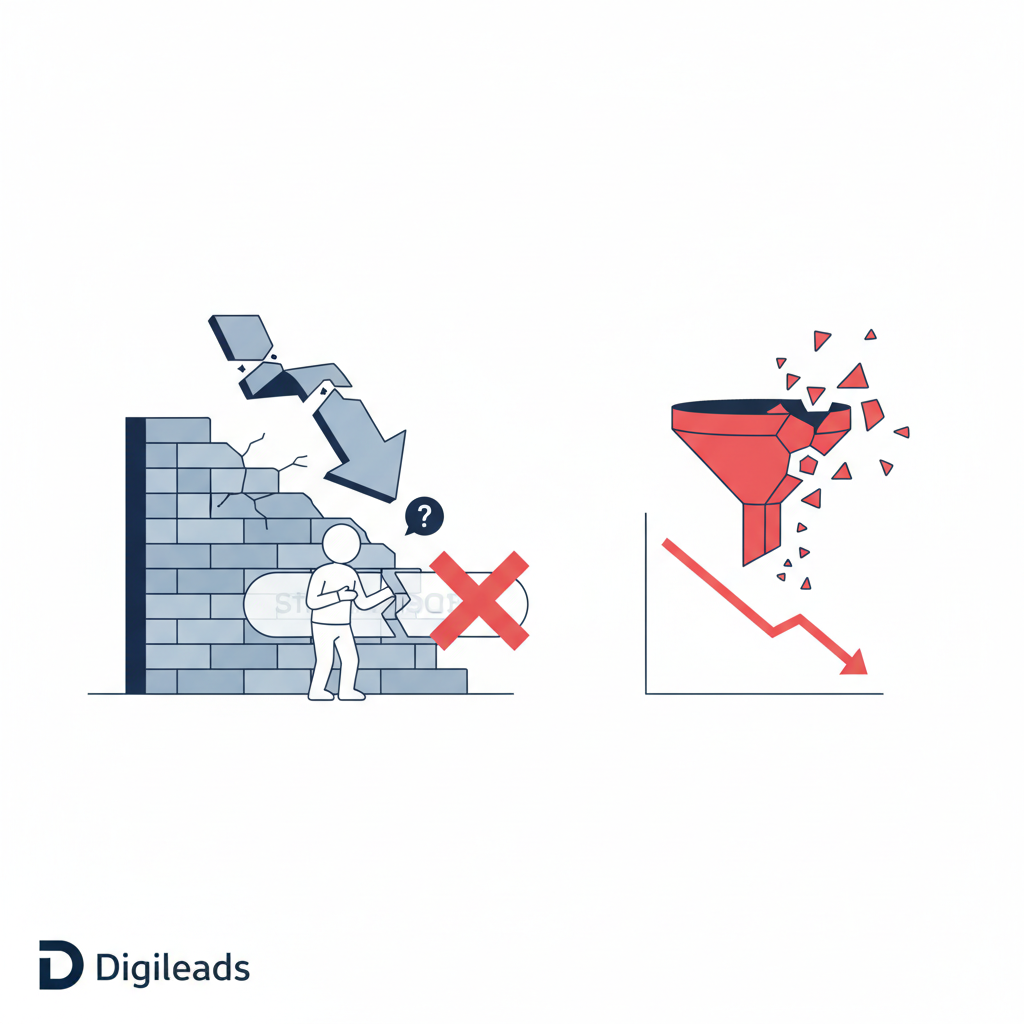
Many B2B websites fail at the final hurdle – they don’t clearly tell visitors what to do next. Weak calls-to-action (CTAs) are a leading cause of poor B2B lead conversion rates.
Generic CTA Copy
“Submit,” “Click Here,” or “Learn More” tell visitors nothing about the value they’ll receive. These generic phrases lack urgency and fail to communicate benefit.
Better alternatives: “Get Your Free ROI Assessment,” “Download the Complete Guide,” or “Book Your Strategy Session.”
Poor CTA Placement
CTAs buried at the bottom of pages or hidden in sidebars won’t drive conversions. Strategic placement throughout the user journey is essential for maximising lead capture opportunities.
Best practice: Include relevant CTAs above the fold, within content sections, and at natural decision points throughout your website.
Too Many Options
Choice paralysis is real in B2B environments. Presenting visitors with multiple competing CTAs dilutes focus and reduces conversion rates.
Solution: Identify your primary conversion goal for each page and make that CTA prominent whilst minimising competing actions.
Conversion Killer #3: Lack of Trust Signals
B2B purchases involve significant risk and multiple stakeholders. Without adequate trust signals, prospects won’t feel confident enough to share their contact information.
Missing Social Proof
Case studies, testimonials, client logos, and reviews provide essential third-party validation. B2B buyers want evidence that you’ve successfully solved similar problems for comparable companies.
Implementation tip: Feature specific, quantified results rather than generic praise. “Increased lead generation by 150% in 6 months” is more compelling than “Great service.”
Unclear Company Information
Anonymous websites don’t generate leads. Prospects need to see real people, company history, team credentials, and contact information before they’ll trust you with their details.
Must-have elements: Detailed About page, team photos and biographies, company address, phone number, and relevant industry certifications.
Poor Security Indicators
SSL certificates, privacy policies, and data protection statements aren’t optional in today’s environment. B2B prospects are increasingly concerned about data security and compliance.
When Your B2B Website Not Converting Due to Content Misalignment
Even websites with good UX and strong CTAs can fail if the content doesn’t match visitor intent or speak to their specific challenges.
Generic Messaging
“We help businesses grow” could apply to any company in any industry. Generic value propositions don’t resonate with specific buyer personas or address particular pain points.
Solution: Develop distinct messaging for different buyer personas and create targeted landing pages for various traffic sources.
Feature-Focused Instead of Benefit-Driven
B2B buyers don’t care about your product features – they care about outcomes. Content that focuses on what your solution does rather than the problems it solves fails to connect with buyer motivations.
Reframe approach: For every feature, clearly articulate the business benefit and quantify the potential impact where possible.
Wrong Stage Content
Serving bottom-funnel content to top-funnel visitors (or vice versa) creates misalignment. Visitors in research phase need educational content, whilst those ready to buy need product demos and pricing information.
The Conversion Diagnostic Checklist
Use this systematic approach to identify why your B2B website not converting and prioritise fixes based on potential impact:
Technical Foundation
- Page load speed under 3 seconds on desktop and mobile
- Fully responsive design across all devices
- SSL certificate installed and working
- Contact forms functioning properly
- Analytics and conversion tracking implemented
User Experience Audit
- Clear navigation with logical information architecture
- Value proposition visible within 5 seconds
- Consistent branding and professional design
- Easy-to-find contact information
- Search functionality (for larger sites)
Content and Messaging Review
- Benefit-focused headlines and copy
- Industry-specific language and examples
- Clear differentiation from competitors
- Addresses common buyer objections
- Appropriate content for different buyer journey stages
Conversion Elements Check
- Compelling, action-oriented CTA copy
- Strategic CTA placement throughout site
- Multiple conversion opportunities (forms, phone, chat)
- Progressive profiling for return visitors
- Thank you pages with next steps
Trust Signal Assessment
- Customer testimonials with names and companies
- Detailed case studies with quantified results
- Client logos and success metrics
- Team photos and credentials
- Industry certifications and awards
- Privacy policy and data protection information
Implementing Your Conversion Improvement Plan
Don’t try to fix everything simultaneously. Prioritise changes based on:
High impact, low effort: Start with quick wins like improving CTA copy, adding testimonials, or fixing broken forms.
High impact, high effort: Schedule major projects like website redesigns or comprehensive content audits for later phases.
Testing and measurement: Implement changes systematically and measure results. Use A/B testing for significant modifications and track conversion rate improvements over time.
Moving Beyond Basic Conversion Issues
Once you’ve addressed fundamental website conversion problems, consider advanced optimization tactics:
- Personalisation based on traffic source or company size
- Dynamic content that adapts to visitor behaviour
- Lead scoring integration with your CRM system
- Multi-step forms to increase completion rates
- Exit-intent popups with compelling offers
Remember, conversion optimization is an ongoing process, not a one-time fix. Regularly review your website performance, conduct user research, and test new approaches to maintain and improve your lead generation results.
Your B2B website should be your most effective salesperson, working 24/7 to generate qualified leads. If it’s not converting visitors effectively, every day you delay fixing these issues costs you potential revenue and competitive advantage.
Ready to transform your website into a lead generation machine? Our team specialises in diagnosing and fixing B2B website conversion issues. Book a free website audit today and discover exactly what’s preventing your site from converting visitors into valuable leads.