
Somewhere in your business right now, someone is asking a version of this question: “Why are we paying an agency when AI can do this for a fraction of the price?”
It might be your CFO reviewing the marketing line item. It might be a board member who just watched a demo of the latest AI content tool. It might even be you.
And it’s a fair question. AI tools can now write blog posts, generate ad variations, build landing pages, and analyse campaign data in minutes, tasks that used to justify a significant portion of an agency retainer. The cost difference on paper is dramatic: a stack of AI subscriptions might cost a few hundred dollars a month, while a traditional agency retainer runs into the thousands.
So the pressure is real, and it’s growing. But the way most businesses frame this decision is exactly why so many of them get it wrong.
Why companies are considering replacing agencies with AI
Three forces are converging at once:
AI output quality has crossed a threshold. For routine marketing tasks (first-draft content, ad copy variations, basic reporting) AI is genuinely good enough. The gap between “AI draft” and “junior copywriter draft” has closed.
Agency deliverables have become commoditised. If your agency’s core deliverable is “4 blog posts per month and a report,” it’s reasonable to ask whether a tool can do that. In many cases, it can.
Buyers are researching differently. More of the buying journey now happens in search results, AI answer engines, and peer conversations, before anyone fills in a form. Publishing generic content into that environment produces less and less return, whoever (or whatever) writes it.
In other words: the pressure to cut agency costs is colliding with a moment where generic marketing output is worth less than ever. That combination is what makes this decision genuinely high-stakes.
The mistake most businesses make when comparing the two
Most comparisons of AI vs marketing agencies are framed as a cost question: “AI costs X per month. The agency costs ten times that. Same blog posts. Easy decision.”
That framing contains a hidden assumption, that the output (content, posts, campaigns) is the thing you’re actually buying. It isn’t.
What you’re actually buying from marketing is outcomes: qualified leads, shorter sales cycles, buyers who arrive at your sales team already confident in the decision they’re about to make. Content is just one input into that.
When you compare AI and agencies on the cost of output, AI wins every time. When you compare them on the cost of outcomes, the picture changes completely, because volume of content has almost no correlation with pipeline. A business publishing 20 AI-generated posts a month with no strategy will typically generate less revenue than one publishing four strategically-engineered decision assets a quarter.
The real question buyers should be asking
The real question isn’t “AI or agency?”
It’s: “Which option gives buyers what they need to confidently choose us, and what does it cost to get there?”
That question changes everything about how you evaluate your options, because it forces you to compare strategy, execution, accountability, and results, not just the price of words on a page.
The rest of this guide compares your three real options through that lens: what each one costs, what each one risks, and which businesses each one suits best.
The Three Options
Despite how the debate is usually framed, you don’t have two options. You have three.
Option 1: Replace Your Agency with AI
You cancel the retainer, subscribe to a stack of AI tools, and have your internal team run marketing with AI doing the heavy lifting.
Pros
Dramatically lower direct costs, tool subscriptions instead of retainers
Speed: content, ad copy, and reports produced in minutes, not weeks
Full control: no briefing cycles, no revision rounds, no account managers
Excellent for high-volume, repetitive tasks (variations, summaries, first drafts, resizing, repurposing)
Cons
AI executes instructions; it doesn’t set direction. Someone still has to decide what to say, who to say it to, and why it will convert, and that someone is now you
Output tends toward the generic. AI is trained on what everyone else has already published, which makes true differentiation structurally difficult
No accountability for results. A tool can’t own a pipeline number
Hidden internal cost: prompting, editing, fact-checking, and quality control all land on your team
Best suited for: Businesses with a strong in-house strategist, an established brand voice, a documented marketing playbook, and marketing goals centred on volume and efficiency rather than pipeline growth.
Option 2: Keep Your Agency but Ignore AI
You stay with a traditional agency running a conventional playbook, monthly content, some SEO, some paid media, delivered the way it’s been delivered for the past decade.
Pros
Human strategy, creativity, and judgement stay in the mix
A team that understands your brand, market, and history
Someone is accountable for delivery (though not always for outcomes)
No internal disruption, marketing continues without change management
Cons
You’re paying human rates for tasks AI now does in seconds, which means part of your retainer funds inefficiency
Traditional deliverable models (“4 blogs a month”) were built for a search landscape that no longer exists; buyers increasingly get answers without ever clicking through
Slower turnaround and higher production costs than AI-augmented competitors
If the agency measures itself on traffic and rankings rather than pipeline, you inherit that misalignment
Best suited for: Businesses in slow-moving categories where relationships and brand continuity matter more than speed, and where the current agency is demonstrably delivering pipeline, not just activity.
Option 3: Work with an AI-Powered Strategic Agency
The third option, and the one most comparisons skip, is an agency that has rebuilt its model around AI rather than in denial of it. Humans own strategy, positioning, and accountability; AI accelerates research, production, and iteration.
At Digileads, this model is called Buyer Decision Engineering: instead of producing content for volume, we engineer the specific assets your buyers need at the moment of decision, comparison pages, cost guides, risk breakdowns, and decision tools, then distribute them where your buyers actually research.
Pros
Strategy-led: work starts from a buyer intent (“should I hire an agency or use AI?”, “what does implementation cost?”) rather than a keyword list
AI-accelerated production means senior-level output at a fraction of traditional agency timelines and cost
Assets are built to convert, not just to rank, designed around the questions that block deals
Clear accountability: success is measured in leads, pipeline influence, and sales-cycle speed, not post counts
Marketing and sales work from the same assets, closing the classic gap between the two
Cons
Higher investment than a pure AI-tool stack
Requires collaboration: your team’s expertise and proof (case studies, results, sales objections) are raw material for the work
Results compound over a 90-day cycle rather than appearing overnight
Best suited for: B2B businesses with a considered sales process, multiple stakeholders in the buying decision, and a goal of generating qualified pipeline, not just publishing more content.
Costs, Timeline & Investment
Here’s what each option actually costs once you include the parts that don’t appear on the invoice.
Option 1: Replacing your agency with AI
Investment: a monthly tool budget that scales with your stack… even a fully loaded stack costs a fraction of a typical agency retainer.
Hidden costs: The subscription is the smallest line item. The real costs are:
Strategy vacuum: the fee you were paying for direction disappears, but the need for direction doesn’t. It transfers, unfunded, to your team
Editing and quality control: AI first drafts need human review for accuracy, brand voice, and originality. Teams consistently underestimate this at 30–50% of the original writing time
Tool sprawl: stacks grow, subscriptions overlap, and integration time adds up
Opportunity cost of mistakes: publishing generic or inaccurate content at scale can damage rankings, credibility, and AI-answer-engine visibility in ways that take months to repair
- Internal resource requirements: Realistically 0.5–1 full-time equivalent to prompt, edit, publish, distribute, and measure, plus someone senior to own strategy. If that person doesn’t exist, the model doesn’t work. (This is the single most common failure point)
- Time commitment: Ongoing and permanent. AI compresses production time but expands management time.
- Expected outcomes: Higher output volume, faster turnaround, lower direct spend. Pipeline impact is typically flat or negative unless strong in-house strategy already exists, more content pointed in the wrong direction simply gets you nowhere faster.
Option 2: Traditional agency
Investment: a significant monthly retainer, typically several multiples of a full AI tool stack.
Typical deliverables: Monthly content (commonly 2–4 blog posts), SEO maintenance, social posting, paid media management, monthly reporting.
Common limitations: Deliverables are measured in activity (posts published, keywords tracked) rather than outcomes (leads, pipeline). Strategy is often set once a year and rarely revisited. Production is slower and more expensive than AI-augmented alternatives, and much of the retainer now pays for work AI could accelerate.
Expected timeline: SEO-led programmes typically take 6–12 months to show meaningful organic results, with lead impact often unclear because attribution stops at traffic.
Option 3: Buyer Decision Engineering
Deliverables (per 90-day cycle):
One flagship Decision Asset: the definitive page that helps your buyer choose, justify, and buy (like the one you’re reading now)
A Decision Kit: a practical gated tool your buyers use internally, calculators, scorecards, templates
6–10 supporting pages engineered around the exact questions and objections that block your deals
A sales enablement pack so your sales team deploys the same assets in live deals
Active distribution across LinkedIn, email, and search, publishing isn’t the same thing as distribution
Expected outcomes: Qualified leads from buyers already deep in the decision process, faster deal progression (buyers arrive pre-answered), and a growing library of assets your sales team uses daily.
Time to first results: The flagship asset and kit ship within the first 2–3 weeks; lead capture begins as soon as distribution starts, not after a six-month SEO ramp.
Long-term value: Unlike monthly content that depreciates the day it’s published, decision assets compound. After three or four cycles, you own a library of the most valuable pages in your industry, the ones that sit at the exact point of purchase.
Risks & How to Reduce Them
The Biggest Risks of Replacing Your Marketing Agency with AI
If you’re leaning toward Option 1, go in with clear eyes. These are the five failure patterns we see most often, and how Buyer Decision Engineering is designed to prevent each one.
Risk 1: More content. Less strategy.
AI makes production nearly free, so teams produce more. But without a strategist deciding which buyer intent each piece serves, volume becomes noise: dozens of pages competing with each other, none of them answering the questions that actually close deals.
How Buyer Decision Engineering reduces this: Every cycle starts with a single buyer intent, one specific decision your buyers are trying to make. Every asset produced maps to that intent. AI accelerates the production; a human strategist owns what gets made and why.
Risk 2: Inconsistent messaging.
Different tools, different prompts, different team members: within months, your positioning drifts. Your homepage says one thing, your blog another, your sales deck a third. Buying committees notice, and inconsistency reads as risk.
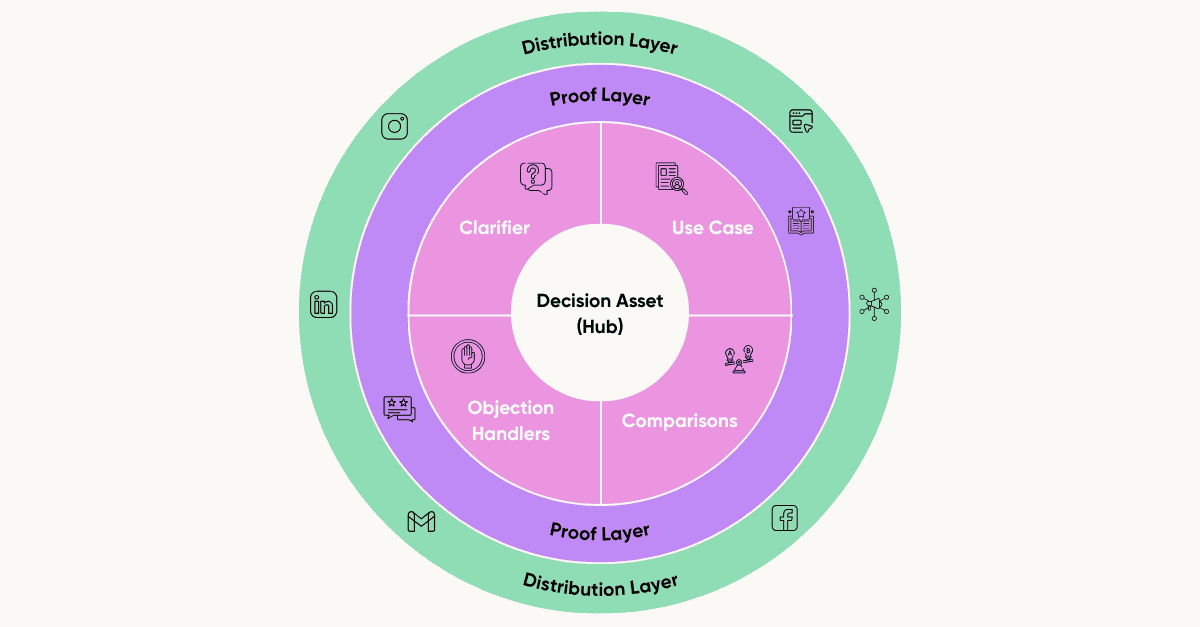
How Buyer Decision Engineering fixes it: The Decision Asset acts as the canonical source of truth for how you talk about the problem, the options, the costs, and the proof. Every supporting page, LinkedIn post, email, and sales conversation draws from the same hub, so the message a CFO hears matches the one the marketing manager read.
Risk 3: Traffic without conversions.
AI-generated content can rank, and increasingly gets cited in AI answer engines. But informational traffic doesn’t buy anything. Generic “what is X” posts attract researchers, not decision-makers, and give them no reason to talk to you.
How the methodology creates decision assets instead: BDE deliberately builds for the decision stage: costs, comparisons, risks, implementation, ROI. These pages attract fewer visitors but the right ones, buyers actively choosing, and every page routes them to a practical next step (a kit, a calculator, a conversation) rather than a dead end.
Risk 4: No accountability.
When a campaign built on AI tools underperforms, who’s responsible? The tool won’t own it. The team member prompting it wasn’t hired to own pipeline. Underperformance gets discovered late, in a quarterly review, when two quarters of budget are already gone.
How governance solves this: A BDE engagement runs on a weekly operating loop: what shipped, what was distributed, what was refreshed, and what the numbers say, tracked against agreed KPIs (kit downloads, qualified leads, influenced opportunities, sales-cycle speed). One named team owns the outcome. You always know what’s working, what isn’t, and what’s being changed.
Risk 5: Marketing and sales become disconnected.
This is the quiet cost of DIY AI marketing: marketing produces content, sales never uses it, and the two functions drift further apart. Buyers feel the gap, what they read online doesn’t match what sales tells them.
How decision assets close the gap: Decision assets are built with sales input (real objections, real deal blockers) and deployed by sales in live deals. The same cost guide a prospect finds through search is the one your salesperson sends after a discovery call. Marketing and sales stop running parallel plays and start running the same one.
Why This Approach Works
Strategy claims are cheap, so here’s the logic, and the evidence.
The logic is simple: buyers don’t struggle to find content; they struggle to make decisions. The businesses that win are the ones present at the moment of decision, with clear options, honest costs, handled risks, and proof. That’s not something an AI tool can decide to build for you, and it’s not something a traditional content calendar will ever prioritise. It has to be engineered.
Methodology Diagram
Which Option Is Right for Your Business?
Strip away the noise and the decision comes down to what you’re actually trying to achieve:
| If your goal is… | Best option |
| Produce more content quickly | AI |
| Reduce copywriting costs | AI |
| Replace repetitive work | AI |
| Increase website traffic | Agency + AI |
| Generate more qualified leads | Buyer Decision Engineering |
| Shorten the sales cycle | Buyer Decision Engineering |
| Help buyers make confident decisions | Buyer Decision Engineering |
| Build long-term marketing assets | Buyer Decision Engineering |
Notice the pattern: AI wins on output. Buyer Decision Engineering wins on outcomes. If your marketing goals are measured in words published, choose the tools. If they’re measured in pipeline, choose the approach engineered to produce it.
And if you’re genuinely torn, that’s usually a sign your current marketing is optimised for activity rather than results, which is exactly the problem worth fixing first.