

If your B2B marketing team is still measuring success by keyword rankings and organic traffic volume, you’re optimising for the wrong things. A genuine B2B SEO strategy beyond keywords is what separates businesses that generate consistent pipeline from those that attract clicks that go nowhere. The rise of Buyer-Driven Engagement — or BDE — has fundamentally changed what good SEO looks like for B2B companies. This post unpacks exactly why, and what you should be doing instead.
What Is Traditional SEO — and Why It Falls Short in B2B
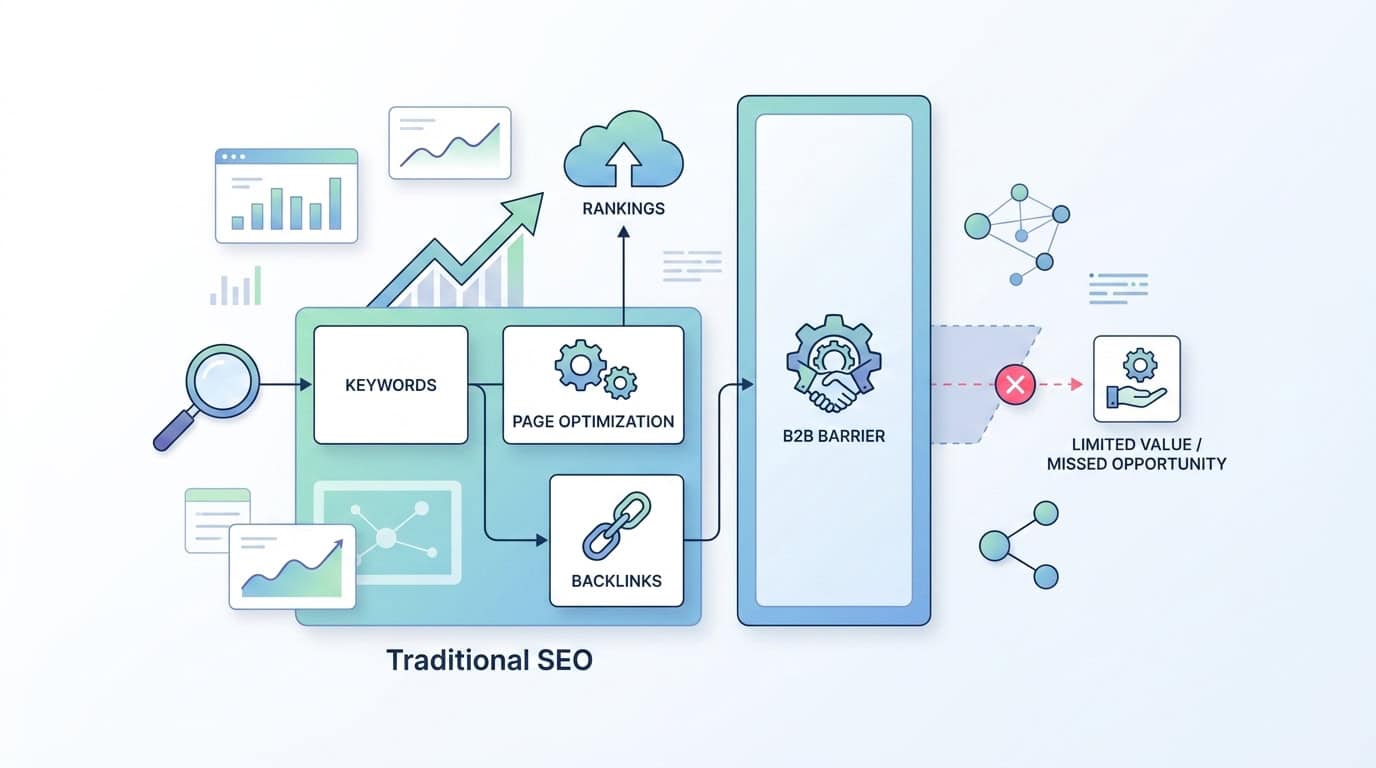
Traditional SEO is built on a simple premise: identify the keywords your audience searches for, optimise your pages around those terms, earn backlinks, and climb the rankings. For consumer brands and e-commerce businesses, this model still delivers real value. Intent is often transactional. Someone searches, someone buys.
B2B buying is nothing like that.
In B2B, the average purchase decision involves multiple stakeholders, extended evaluation periods, and a great deal of research that happens before anyone fills in a contact form. A potential buyer might read your content for months before they’re ever ready to speak to your sales team. Traditional SEO captures the moment they search. BDE is designed to win the entire journey.
The problem with purely keyword-driven SEO in a B2B context is threefold:
- Traffic doesn’t equal pipeline. You can rank for dozens of terms and attract thousands of monthly visitors who are never going to become customers — wrong industry, wrong role, wrong intent.
- Keywords are backward-looking. They tell you what people have searched for historically. They don’t tell you what your ideal buyers are actually thinking about right now.
- Rankings are fragile. Algorithm updates, AI-generated search features, and increasing competition mean a page-one position today can disappear tomorrow. Building a business on rankings alone is building on sand.
What Is BDE — and How Does It Reframe Your B2B SEO Strategy Beyond Keywords?
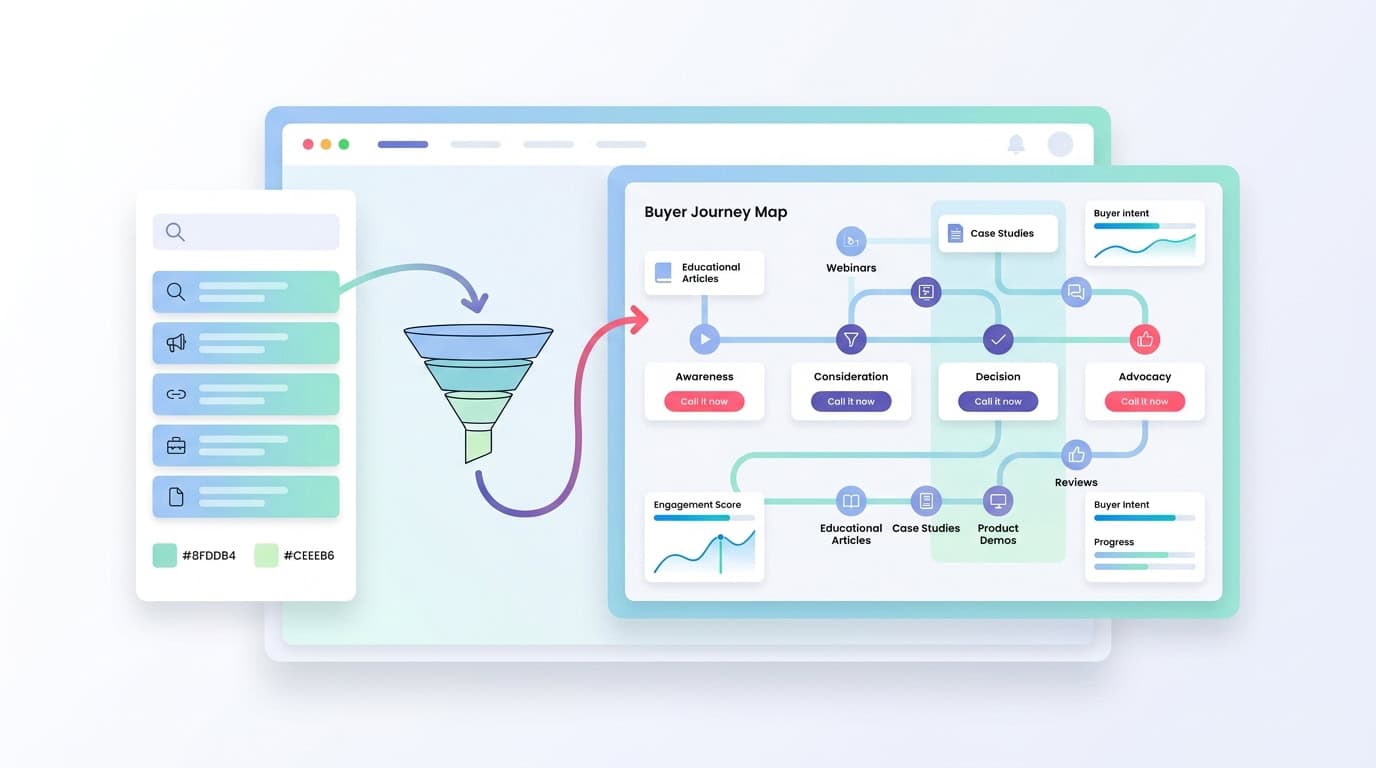
Buyer-Driven Engagement is a framework that puts the buyer’s journey at the centre of every marketing decision. Rather than asking “what can we rank for?”, BDE asks “what does our ideal buyer need to see, read, and believe before they’re ready to buy — and how do we show up at every stage of that process?”
This isn’t about abandoning SEO. It’s about making SEO serve a bigger purpose.
Under a BDE model, search becomes one channel within a broader demand-generation system. Content is created to answer real buyer questions, challenge common misconceptions, and build genuine authority — not to tick keyword boxes. The goal isn’t just to be found. It’s to be trusted.
The Shift from Search Volume to Search Intent
One of the most important changes BDE introduces is moving from search volume as a primary metric to search intent as the primary filter.
A keyword with tens of thousands of monthly searches might be completely irrelevant to your pipeline if the people searching it are at the wrong stage, in the wrong role, or looking for something adjacent to what you sell. Meanwhile, a highly specific, lower-volume search term used by procurement managers or IT directors evaluating solutions like yours is worth far more — even if only a handful of people search it each month.
BDE-aligned SEO prioritises intent-rich content for high-value audiences. That means:
- Creating comparison content that speaks directly to buyers evaluating multiple vendors
- Publishing detailed use-case pages that match specific industry pain points
- Building resource content that answers the exact objections your sales team hears on calls
- Targeting role-specific queries — what a CFO searches is fundamentally different from what a Head of Operations searches, even if they’re both involved in the same purchase
Authority Over Volume: Why Less Can Mean More
Traditional SEO often rewards content volume — more pages, more keywords, more posts. BDE flips this logic. A library of thin, keyword-stuffed articles does nothing to build the kind of authority that moves B2B buyers. What works is depth.
When a senior decision-maker lands on your site during their research phase, they’re making a rapid judgement about whether you understand their world. A 600-word blog post optimised around a search term won’t convince them. A genuinely insightful piece that demonstrates commercial and technical expertise — and actually helps them think through their challenge — will.
Many B2B businesses find that consolidating scattered, shallow content into fewer, more authoritative pieces improves both rankings and conversion rates. Google’s own quality guidance has moved firmly in this direction — rewarding expertise, experience, authoritativeness, and trustworthiness over sheer content quantity.
How BDE Changes What You Measure
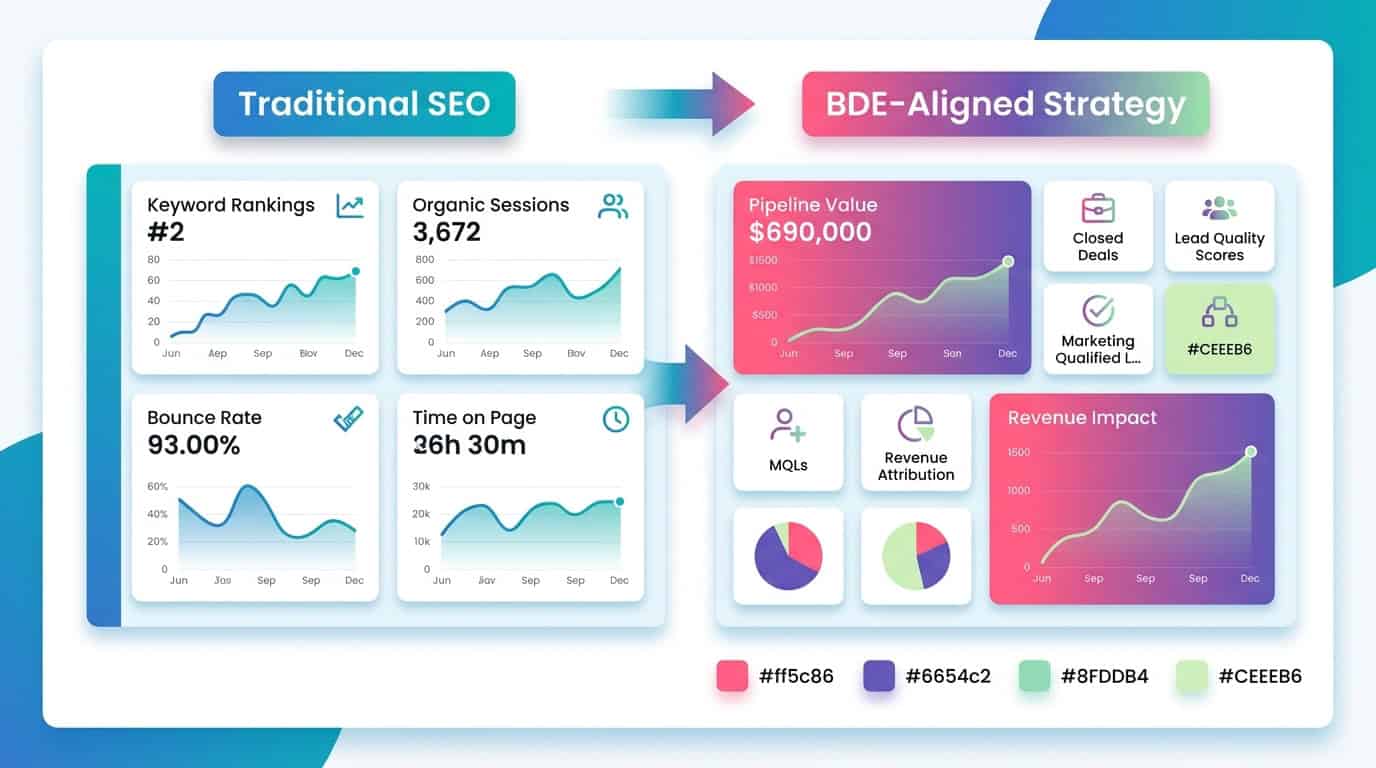
If you’re running a traditional SEO programme, your dashboard probably shows rankings, organic sessions, bounce rate, and maybe time on page. Useful data — but none of it tells you whether SEO is actually contributing to revenue.
A BDE-aligned B2B SEO strategy beyond keywords demands different success metrics:
- Qualified traffic, not total traffic. Are the right people visiting? Use firmographic and behavioural data to understand whether your organic visitors match your ideal customer profile.
- Content-influenced pipeline. Which pieces of content are being consumed by contacts in your CRM before they convert? Map content engagement to deal progression.
- Assisted conversions. Organic search rarely gets the last click in a complex B2B sale. Look at how SEO-driven content contributes across multi-touch attribution models.
- Engagement depth. Are visitors reading to the end? Are they moving to other pages? Are they returning? These signals indicate genuine interest — the kind that precedes a sales conversation.
Practical Steps to Build a B2B SEO Strategy Beyond Keywords
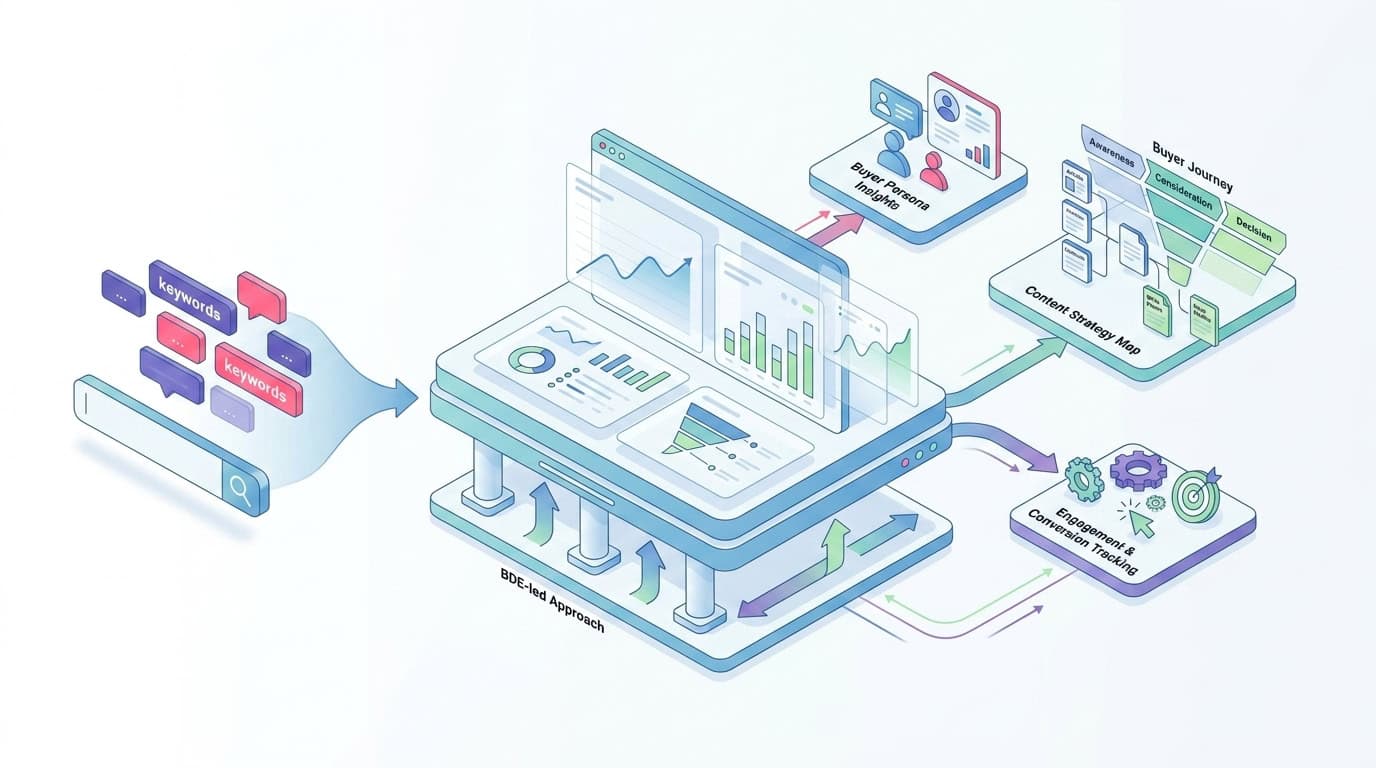
Shifting from traditional SEO to a BDE-led approach doesn’t mean starting from scratch. It means being more deliberate about how your content and search strategy serve the buyer journey. Here’s where to focus:
1. Start With Your Ideal Customer Profile, Not a Keyword Tool
Before you open a keyword research tool, get clear on exactly who you’re trying to reach. Job title, industry, company size, typical challenges, buying triggers, and key objections. Your SEO strategy should be built outward from this profile — not inward from search volume data.
2. Map Content to Buying Stages
Every piece of content you create should serve a clear purpose in the buyer journey. Problem-aware content for early-stage buyers. Solution-aware content for those actively evaluating. Vendor-comparison and proof content for those close to a decision. Most B2B SEO programmes over-index on top-of-funnel awareness content and neglect the middle and bottom of the funnel — exactly where deals are won or lost.
3. Align Sales and Marketing on Content Gaps
Your sales team speaks to potential buyers every day. They know the questions, the hesitations, and the objections that come up repeatedly. That intelligence is a goldmine for content strategy. A regular feedback loop between sales and marketing — focused on what prospects are actually asking — will surface more valuable content opportunities than any keyword report.
4. Build Topical Authority, Not Just Individual Pages
Search engines increasingly reward sites that demonstrate comprehensive expertise across a topic area, not just individual pages that target a single keyword. Build content clusters — a pillar page covering a broad topic supported by interconnected articles going deeper on specific subtopics. This signals authority, improves internal linking, and keeps buyers engaged longer.
5. Treat SEO as a Demand Channel, Not a Traffic Channel
The final — and most important — mindset shift. SEO exists to create demand and capture it. Every strategic decision, from the topics you cover to the calls-to-action you include, should be evaluated against one question: does this move the right buyers closer to a conversation with our team?
The Competitive Advantage Is Real

Most of your competitors are still playing the old game — chasing rankings, publishing content to satisfy editorial calendars, and measuring success in sessions and impressions. That creates a genuine opportunity.
Businesses that adopt a BDE-led B2B SEO strategy beyond keywords now will build a compounding advantage. Better content attracts better-fit visitors. Better-fit visitors convert at higher rates. Higher conversion rates justify more investment in content. The cycle rewards those who start early and stay consistent.
The businesses that win over the next few years won’t just be visible — they’ll be trusted. And trust, unlike a keyword ranking, is very difficult for a competitor to take away.
Ready to Build an SEO Strategy That Actually Drives Pipeline?
At Digileads, we help B2B businesses build demand-generation systems where SEO, content, and sales alignment work together — not in silos. If your current approach is delivering traffic but not deals, it’s time for a different conversation.
Get in touch with the Digileads team today and let’s build a B2B SEO strategy that goes beyond keywords and straight to the bottom line.