

What Is an AI Overview — and Why Does It Matter Right Now?
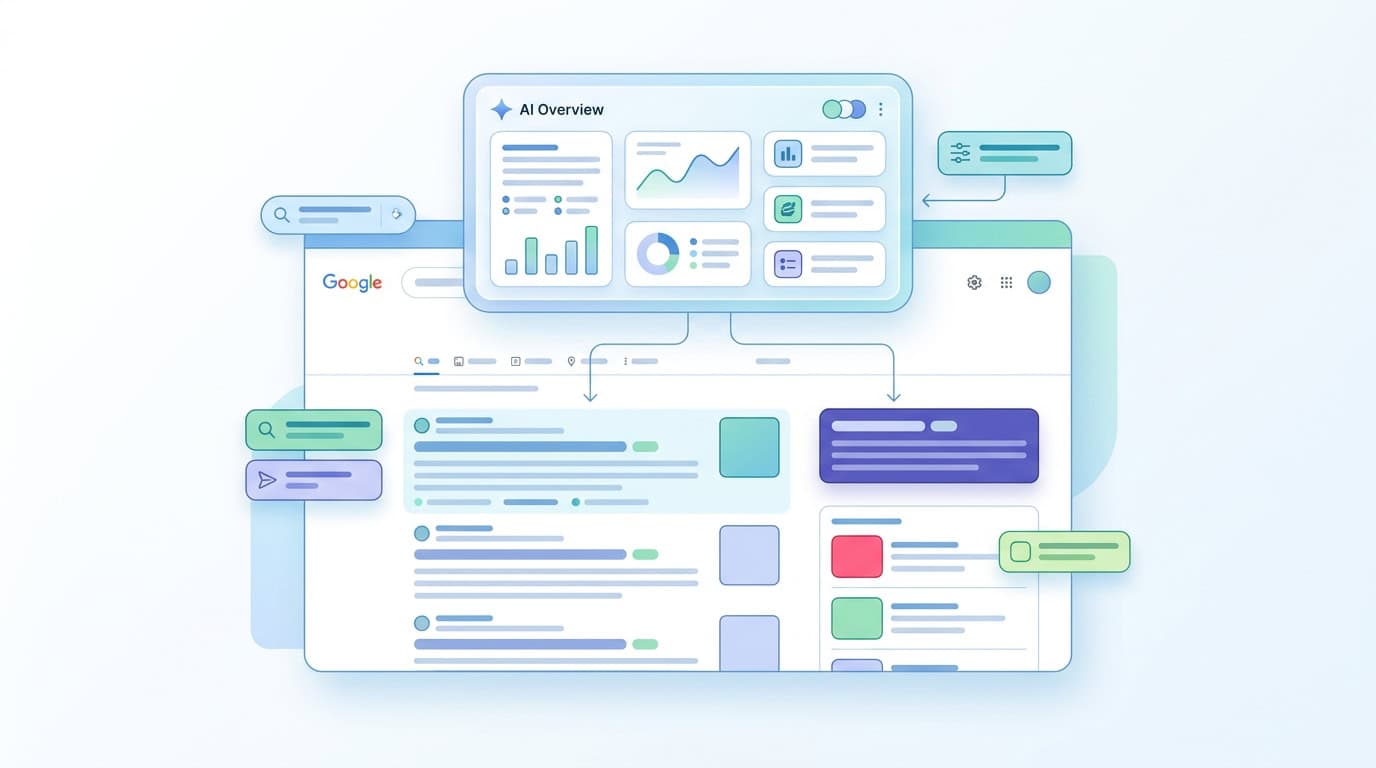
If you’ve searched on Google recently and noticed a blue-tinged panel of AI-generated text sitting above all the traditional results, you’ve encountered an AI Overview. So, what is an AI Overview, precisely? It’s Google’s AI-generated summary that appears at the very top of a search results page (SERP), synthesising information pulled from multiple sources across the web to deliver a direct, conversational answer to a user’s query — before they’ve clicked a single link. Rolled out more broadly through Google’s Search Generative Experience and subsequently refined into what we now know as AI Overviews, this feature represents one of the most significant shifts in how people find information online. For business owners and marketing leaders, that shift has serious commercial implications.
How Does a Google AI Overview Actually Work?
A Google AI Overview doesn’t pull from one authoritative source in the way a featured snippet does. Instead, it uses large language model technology, integrated into Google’s core search infrastructure, to read, synthesise, and summarise content from a range of web pages simultaneously. The result is a cohesive, structured answer written in plain language, often with cited source links displayed alongside or beneath the summary.

Think of it as Google doing the reading for your potential customers. A user types in a complex or research-oriented query, and instead of being presented with ten blue links to sift through, they receive a ready-made answer. The sources that contributed to that answer may get a reference link, but the user’s need is largely satisfied without them ever visiting a website.
What Types of Queries Trigger an AI Overview?
AI Overviews tend to appear most frequently for:
- Informational queries — questions beginning with “what is,” “how does,” “why does,” and similar phrasing
- Comparison queries — “X vs Y,” “best options for Z”
- Multi-part or complex questions — queries that would traditionally require reading several articles to answer fully
- Research and discovery queries — topics where a user is exploring a subject rather than looking for a specific website
Transactional queries, where someone is clearly ready to buy, are less likely to trigger an AI Overview, though this continues to evolve as Google refines its deployment logic.
AI Overview vs Featured Snippet: What’s the Difference?
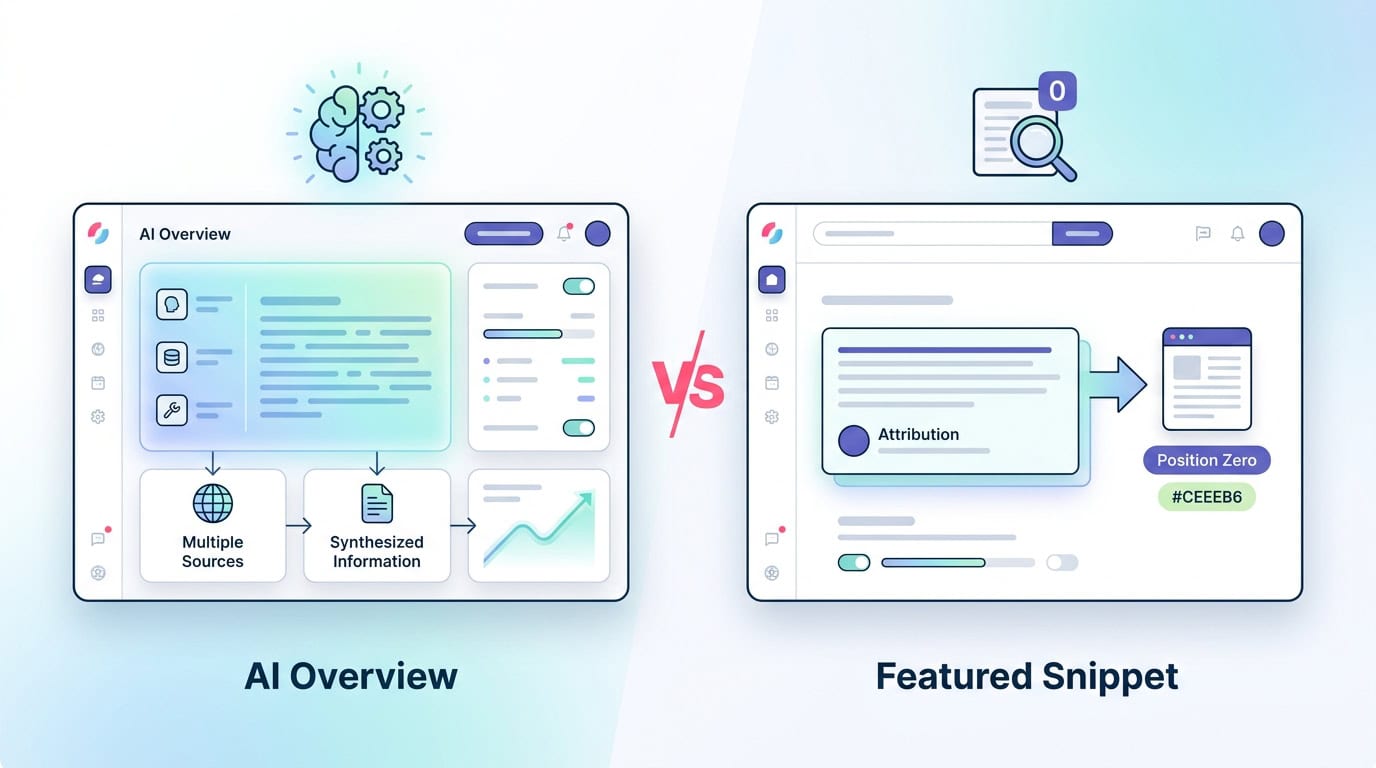
This is one of the most common points of confusion, and it’s worth being precise. A featured snippet, sometimes called “position zero”, pulls a specific excerpt from a single webpage and displays it prominently above organic results. The content is attributed clearly to that one source, and the formatting (paragraph, list, table) mirrors what exists on that page.
An AI Overview is a fundamentally different beast. Rather than surfacing one source’s content, it generates an original synthesis drawing from multiple pages. The language is rewritten, not quoted. The structure is determined by the AI, not lifted from any single article. And whilst sources are cited, no single publisher “owns” the answer in the way they might with a featured snippet.
Key Differences at a Glance
- Source attribution: Featured snippets cite one source; AI Overviews cite several
- Content origin: Featured snippets quote existing content; AI Overviews generate new text
- Click incentive: Featured snippets often encourage a click for more detail; AI Overviews are designed to be self-contained
- Visual position: Both appear above organic results, but AI Overviews are typically more prominent and expansive
- Query types: Featured snippets can appear for simpler queries; AI Overviews tend to target more complex, research-oriented searches
Understanding this distinction matters because the optimisation strategies for each are different. Getting into an AI Overview requires more than having the right paragraph on the right page — it requires building the kind of comprehensive, trustworthy content that Google’s AI deems worth synthesising.
What AI Overview Search Results Mean for Organic Traffic
Let’s be direct: AI Overviews are changing the click landscape, and not in a way that flatters traditional SEO metrics. When a user receives a fully-formed answer at the top of the page, the motivation to scroll down and click through to a website is diminished. This contributes to what’s increasingly referred to as zero-click search — where the search journey begins and ends on the results page itself.
Many businesses are already noticing shifts in their organic traffic patterns, particularly for informational content that previously drove consistent visitors. Blog posts designed to answer common questions — the bread and butter of inbound content marketing — are among the most exposed content types, because they’re precisely the kind of material Google’s AI draws on to construct its Overviews.
This doesn’t mean content marketing is dead. Far from it. But it does mean that the purpose of content is evolving. Content that earns a citation in an AI Overview — even if it doesn’t generate a click — still delivers brand exposure, builds authority signals, and influences how Google perceives your site’s trustworthiness. The goal is no longer just to rank; it’s to be the source Google trusts enough to synthesise.
The Brand Visibility Opportunity
There is a genuine upside here for businesses that move quickly. Being cited in a Google AI Overview places your brand name in front of a user at the most prominent point of their search experience. For businesses in competitive verticals, that’s a form of awareness that even a strong organic ranking doesn’t always guarantee. The businesses that are building content with AI visibility in mind right now are the ones that will own that positioning as AI Overviews become the default search experience.
AI Overview SEO: How Do You Earn a Place in Them?
This is where AI Overview SEO diverges from traditional optimisation. You cannot simply target a keyword, write a 1,000-word post, and expect to appear. Google’s AI is looking for content that demonstrates depth, accuracy, and authority across a topic, content that can genuinely contribute something useful to a synthesised answer.

The discipline most closely aligned with earning AI Overview citations is Generative Engine Optimisation (GEO) — the practice of structuring and framing content so that AI systems, including Google’s, can understand, trust, and cite it accurately. GEO shares principles with Answer Engine Optimisation (AEO), which focuses on positioning your content as the definitive response to specific questions.
Practical Principles for AI Overview Visibility
- Answer questions directly and early. Don’t bury the lead. If your content is about a specific question, answer it clearly in the opening paragraph, then build out the context and detail beneath it.
- Structure content for machine readability. Use clear headings, concise paragraphs, and logical content architecture. AI systems need to parse your content quickly to determine its relevance.
- Demonstrate expertise and credibility. Google’s AI prioritises content from sources it deems authoritative. This means building topical depth across your content ecosystem, not just producing isolated articles.
- Use natural language that mirrors how people ask questions. AI Overviews are triggered by conversational queries, so content written in a conversational, question-answering style is better positioned to be included.
- Keep content accurate and up to date. AI systems are sensitive to content quality signals. Outdated, inaccurate, or thin content is unlikely to be cited in an Overview — and may actively harm your authority signals.
- Build content clusters, not isolated pages. A single well-written article is less powerful than a suite of interlinked content that covers a topic comprehensively from multiple angles.
How Digileads Builds Content That Earns AI Overview Citations
At Digileads, we don’t build content for yesterday’s search landscape. Our Reach module is designed specifically around the realities of modern search — where AI Overviews, featured snippets, and zero-click results are increasingly the norm, not the exception.
Our content strategy is built on the same principles that underpin GEO and AEO. We develop structured, authoritative content that positions our clients as trusted sources within their sectors — the kind of content that Google’s AI turns to when constructing its Overviews. Every piece we produce is created with both the human reader and the AI synthesiser in mind, because in 2024 and beyond, both audiences matter equally.
We don’t chase keyword volumes in isolation. We map content to the full spectrum of questions your prospects are asking, build topical authority across those question clusters, and ensure your brand is present — and citable — at every stage of the search journey. The result is visibility that goes beyond rankings: it’s the kind of presence that earns you a seat at the table when Google decides whose voice to amplify.
The Bottom Line: Adapt Now or Cede Ground
The rise of AI Overviews in Google search results is not a trend to monitor from a distance. It is an active reshaping of how organic visibility works, and businesses that delay adapting their content strategy will find themselves increasingly invisible — even when they’re technically ranking.
The businesses that will win are those that understand what an AI Overview is, why it matters, and how to build content that earns inclusion in it. That means investing in depth over volume, structure over style, and authority over keyword density.
If you’re ready to build a content strategy that’s engineered for the AI search era — one that positions your brand to be cited, trusted, and chosen — speak to the Digileads team today. Our Reach module is built for exactly this challenge, and we’re helping businesses like yours secure visibility where it matters most.